
A Conversation on Independent Publishing with Jess Chandler from Prototype
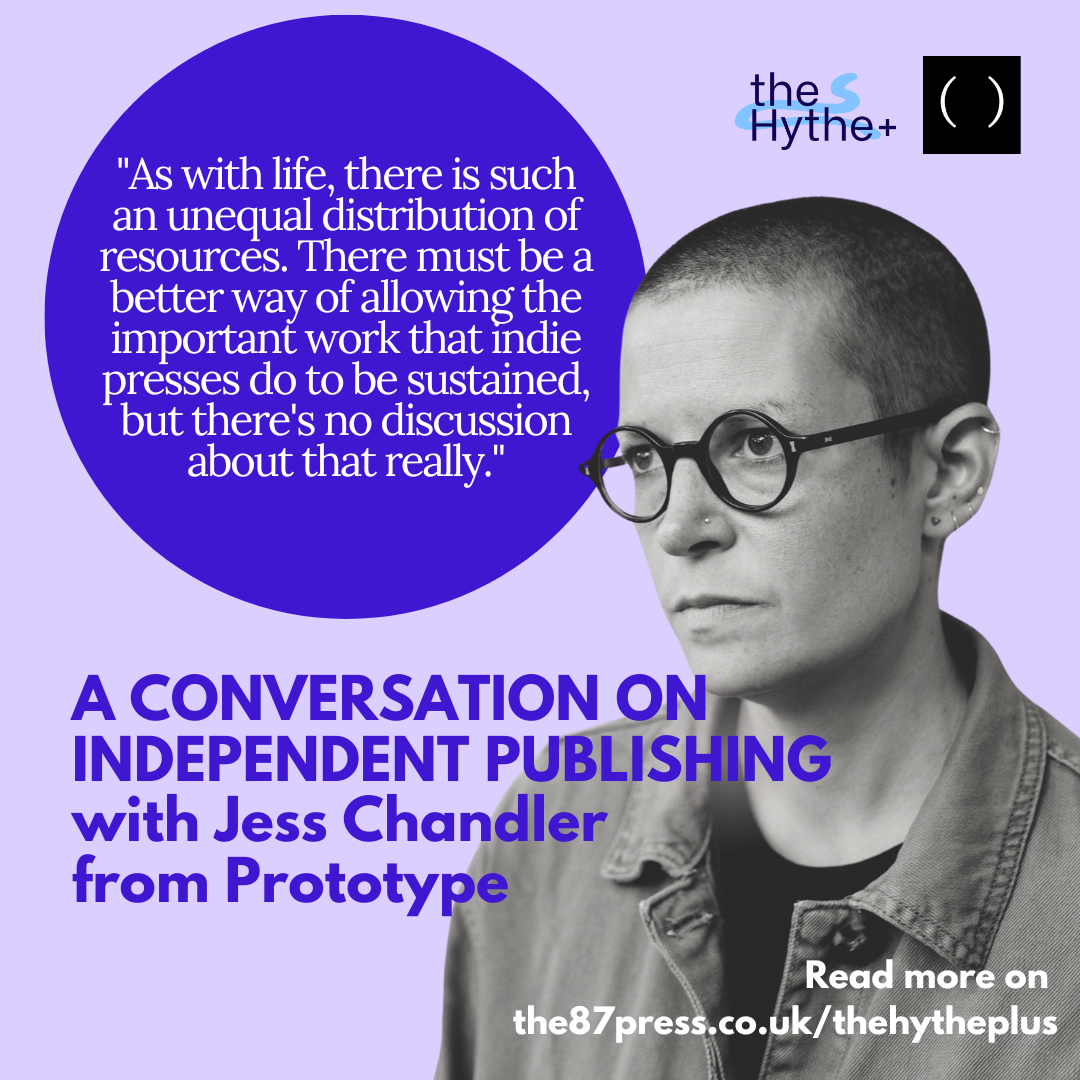
As part of a new series of interviews, we are sitting down with various editors of small presses to develop community and peer-to-peer conversations, offering insight into the precarious world of independent publishing and sharing resources.
To kick the series off our editor Kashif Sharma-Patel speaks to Jess Chandler of Prototype.
What follows in an edited transcript of the conversation.
*
Kashif Sharma-Patel: I am firstly interested in what led you to the field of independent publishing? I know you were part of two presses before Prototype, namely Test Centre and House Sparrow Press, and it would be good to track your trajectory a little.
Jess Chandler: I studied English Literature at university, but after that I was really interested in documentary films, so my first jobs were in factual television. I was working on documentaries, mainly arts and history-related. That was all freelance work; a lot of that industry is just short contracts. It was interesting but my heart was never fully in it. Around that time a friend – who had run a magazine during university and whom I had written reviews for – was also doing freelance reviewing and we both felt frustrated that it paid so poorly and was so time-consuming. We were also not very excited by the outlets we were writing for. So we had the idea to start our own magazine.
We started generating these ideas when I was living in Norway. We were communicating via letters, and by the end of this correspondence we thought that perhaps there were too many magazines already, so we should come up with a different type of project. We decided to focus on spoken word vinyl LPs. We drew up a list of potential writers we liked, wrote letters to them, and four out of five of them said yes. So we started by making a record with the London-writer Iain Sinclair whose background is very much in small press publishing, so he was drawn to the project that we were starting. It felt like it echoed his own early career. That was the start of what became Test Centre. After this series of records we started to publish a very DIY stapled type magazine. The first issue had three contributors, then it grew. We started doing poetry books, and over the course of six or seven years we published lots of more substantial books and ran events. It felt like something that could become more than just a side project. Throughout this time I was still working full time in TV.
We reached a turning-point. We decided to go separate ways – Will Shutes moved out of London and started a second-hand book dealing business. He was an amazing collector of interesting print material. That was my chance to change tac and I decided to start Prototype. The idea was very much to continue what we had done with Test Centre, and I took the archive into Prototype. Maybe my ambition was to make it more commercial, so that it could be my life, rather than juggling other things and working in the evenings.
House Sparrow Press started during Test Centre, and it was set up for one very specific project. It was an essay John Berger had written about a short story by the Russian writer Andrei Platonov, and we had the recording of Berger reading this amazing story which was about poverty, music and the relationship between this man and his sparrow. It was called “A Sparrow's Journey”. Another friend of mine, Gareth Evans, who is a film curator, loved this project and we didn't feel that it was quite right for Test Centre, so we published it under this different name. House Sparrow Press still continues and is now an imprint of Prototype, which seems silly as we are so small, but it has its own distinct aesthetic. We have done books by Anne Michaels, who is on the Booker shortlist this year, and two Derek Jarman books, one of which is about to come out, and a book by the Mexican novelist Chloe Aridjis. That has been a really nice project which just does one thing a year.
As soon as I started Test Centre I understood this was something I wanted to do further. I liked being in charge of my own life, generating my own projects, and that was where I felt most comfortable and energised by things.
KSP: When has it been going from? And were you full-time from the start?
JC: Prototype started in 2019, just after my daughter's birth, and I was doing freelance work at the same time. I was the digital editor for Poetry London at the time, and I did quite a lot of freelance editorial work, which I continue to do now actually. I have been trying to get to a point where I don't need to do that juggling, but the finances of small presses are challenging. That's the goal at least.
KSP: Prototype publishes fiction, poetry, interdisciplinary work and anthologies. Perhaps you could elaborate on your philosophy regarding interdisciplinary work, hybrid writing, and the intersection of artistic and literary form. It makes you stand out from other small publishers.
JC: Towards the end of Test Centre, we received Arts Council funding for a project that consisted of two publications: one by Rachel Allen, who has always done a lot hybrid work collaborating with artists, which included work by the artist Marie Jacotey, and a book by the poet Laura Elliot which was in response to still-life works by the artist Laura Letinsky. The project was focused around this interaction between poetry and visual art. Due to those publications, we began to receive so many projects revolving around art and poetry. It felt like people were sending it to us because there weren't a lot of other outlets doing that kind of thing. Often these projects might require an unusual format or a different way of treating the work, which does not fit with traditional poetry publishing which follows a literal tradition of form. We were finding a niche that could fit nicely alongside mainstream publishing. We had poets who were published by Faber, but who would have another project that didn't quite work with those larger publishers. We were not competing as such, but existing alongside more traditional projects.
When I started Prototype I was certain we should continue in that vein and fill that gap. With Test Centre we only did two novels and I really wanted that to be a focus of Prototype. With poetry publishing there are so many fantastic presses doing interesting things, but I felt that fiction was slightly less open, that there weren't equivalents, that we didn't have the same sort of small press community for fiction. So I tried to take the same approach and apply it to novels, which would also have the potential to sell more copies and make us sustainable.
The anthologies we publish every year which go to subscribers. Seventy percent of contributions are from open submissions, the rest are extracts from our forthcoming titles. We occasionally take on other anthology projects, but they are very time-consuming. Our interdisciplinary strand exists for projects that really do not fit into the poetry or prose categories, though usually those projects need some form of external funding as they are harder to market and more expensive to produce.
It all fits together under a hybrid approach, but I liked the idea of having all these different strands.
KSP: Has it been difficult in maintaining the identity of the press and how have you communicated that (through design for instance)?
JC: For our prose – which I say instead of fiction as I want to be open to different kinds of prose-writing – we do have a series design. One of the reasons was definitely to highlight the identity of that strand, and build up a trust with readers. Once readers are aware, you can experiment a bit more as that connection has been established. They trust the quality and its maintenance over time. For poetry we do not have any sort of series design or format. Each book is completely different. I hope that that in itself becomes an identity. It is different from other poetry presses I think. I believe different poetry collections require different formats and I like allowing that freedom. We offer something quite different in that way, getting poets involved in the design and form of their collection. I feel that attracts certain writers to us who believe the form is very important for them.
Sometimes I wonder if each strand should have its own series design, but I think it is working well at the moment. I don't think it is working against us. There is an identity there, even though it is not always through uniform repetition. I see it more through the care and quality of the books. It is a good question. How do you become recognised, how do you compete when there is so much being published? I suppose my approach with that is to take a slightly different approach and see if it establishes a reputation of its own.
KSP: I am keen to get your opinion about how you see the current climate of publishing. Prototype, like the87press, sit at the cusp of experimental-innovative strands of writing and more conventional and commercial settings. It is a small space of great potential and importance, but it feels increasingly squeezed. How do you see it from your part of that world?
JC: It feels incredibly challenging. That is my honest answer. The print costs and distribution costs are so crippling, it is really worrying. It feels that the only way of staying sustainable is to be more commercial. You need higher print runs and much higher sales figures. Without funding I don't see how it is possible. But I am sure even with funding, it doesn't mean you are free from all of these worries. I am constantly thinking about our finances, and it keeps me awake at night. I feel excited about the books that we publish and I like the place that we sit. Like you said between a small press culture, with that community which is so important, and crossover and being acknowledged by a wider readership as well. But it feels like a very difficult place to exist, or remain. You are hoping that the trajectory will take you to a place of sustainability. If it doesn't you have to scale back and accept that it is not going to be your full-time living. I am not sure if you can stay in that space forever. It's not small enough that it is easy to sustain your life with other things, but it's not big enough that you can relax with the press as your sole concern. Does that sound familiar?
KSP: Yes it sounds familiar - that squeezed space.
JC: Exactly, and I need more people to work with. I have one part-time colleague who does a huge amount as well, but that's it, alongside brilliant freelance designers. But trying to do everything yourself is difficult and takes away from focusing on what is most important, or where I feel my skills should be focused.
KSP: We started in 2018, you started in 2019, which was an optimistic moment around small presses. There seemed to be a wave of innovative writing, a focus on diversity and old voices which hadn't quite found their space yet. Now, whether it's due to the cost-of-living crisis or Covid, momentum feels lost.
JC: I do feel that presses are disappearing. People are unable to sustain them, even though there has also been a change in independent presses becoming increasingly well-respected. There have been huge successes in prize culture for instance. Indie publishing in many ways is in a very good position, but only a few manage to be successful and sustainable. I get frustrated when I go to London Book Fair, for example, and I am reminded just what a hugely profitable industry publishing is. As with life, there is such an unequal distribution of resources. There must be a better way of allowing the important work that indie presses do to be sustained, but there's no discussion about that really.
KSP: I am hoping with conversations like this we can build some sort of forum, at least amongst ourselves. And what future plans do you have for the press? I note the recent award show at the SLG which is an important development in small press culture.
JC: The award event was a culmination of about two years of planning, which was to set up a prize for the kind of work we have always been interested in publishing. We set it up with a sense that while there are some interesting prizes out there, there is nothing quite in that area of hybrid writing. In setting it up I hoped that kind of writing could get a slightly bigger platform. We have partnered with Frieze magazine who will publish extracts of the two winning pieces. There are two prizes: one for a book-length work and one for short-form which we have partnered with Monitor Books. Also we felt we wanted to bring short-form work into the fold as it also gets disregarded and doesn't get enough attention as its own approach. We had three judges: the poet Bhanu Kapil, the novelist Tom McCarthy and the artist Elizabeth Price. We had over 500 submissions, and it has been a really exciting thing. The standard of the work that was submitted was really amazing. The number of people who have been developing these really complex and impressive projects independently was really exciting and encouraging.
We are hoping to run that prize every two years. We had some arts council funding, and we had three private funders who gave part of the prize money. That was also an interesting model to try out. Could we invite some donations from people involved in the art world alongside public funding. In parallel we also set up a development programme, in effect a mentoring programme, running over six months, which we have just finished. It offers support for underrepresented and early career artists and writers working in that area. We had a series of workshops and close editorial sessions during the period. There isn't enough support for people working in that area, so it felt important to run these in conjunction. We will be applying to the Arts Council again to continue and expand the whole project.
Another thing, we are starting to publish more and more works in translation, for the simple reason that there is so much work still to be discovered through that method. Thinking practically, it is a good model because there is often support from those countries. You often get translation costs covered and it could be more sustainable. That is exciting.
Otherwise, just trying to get to a position of sustainability, which may or may not happen. That is the constant challenge, and trying to be creative and open-minded for how that happens. There are lots of plans for books but underlying all of that is a need for a model of sustainability in terms of it being a way of working that doesn't make you burnout.
KSP: Great, any last thoughts?
JC: You mentioned that forums like this as being a place for sharing ideas and problems, and I think that is what I love most of all about being an independent, smaller publisher. I really do think there is an amazing openness and willingness to share amongst similar publishers. I really value that. I would be sad to lose that and move away. That is part of the problem about what kind of publisher you want to be – do you want to be bigger and lose your community. I really value that community.
*
Jess Chandler founded Prototype in 2019. She was a co-founder of Test Centre, which ran from 2011 to 2018, publishing innovative works of poetry and fiction. She also co-runs, with Gareth Evans, the imprint House Sparrow Press. She has worked as an editor at Reaktion Books, and used to work as a researcher and producer on factual television programmes. She was the Digital Editor of Poetry London for six years. Jess has extensive experience editing and publishing a range of books, from fiction and poetry to illustrated art books, literary biography, history and philosophy, specialising in poetry and hybrid, multidisciplinary works. Jess has been invited to give talks and seminars at institutions including Glasgow School of Art, Birkbeck and the Royal College of Art, and has been a tutor at the Poetry School.