
“I find it interesting how independent businesses now ape the aesthetics of radical bookshops without any genuine anti-capitalist or anti-imperialist commitment”: In Conversation with Al Anderson
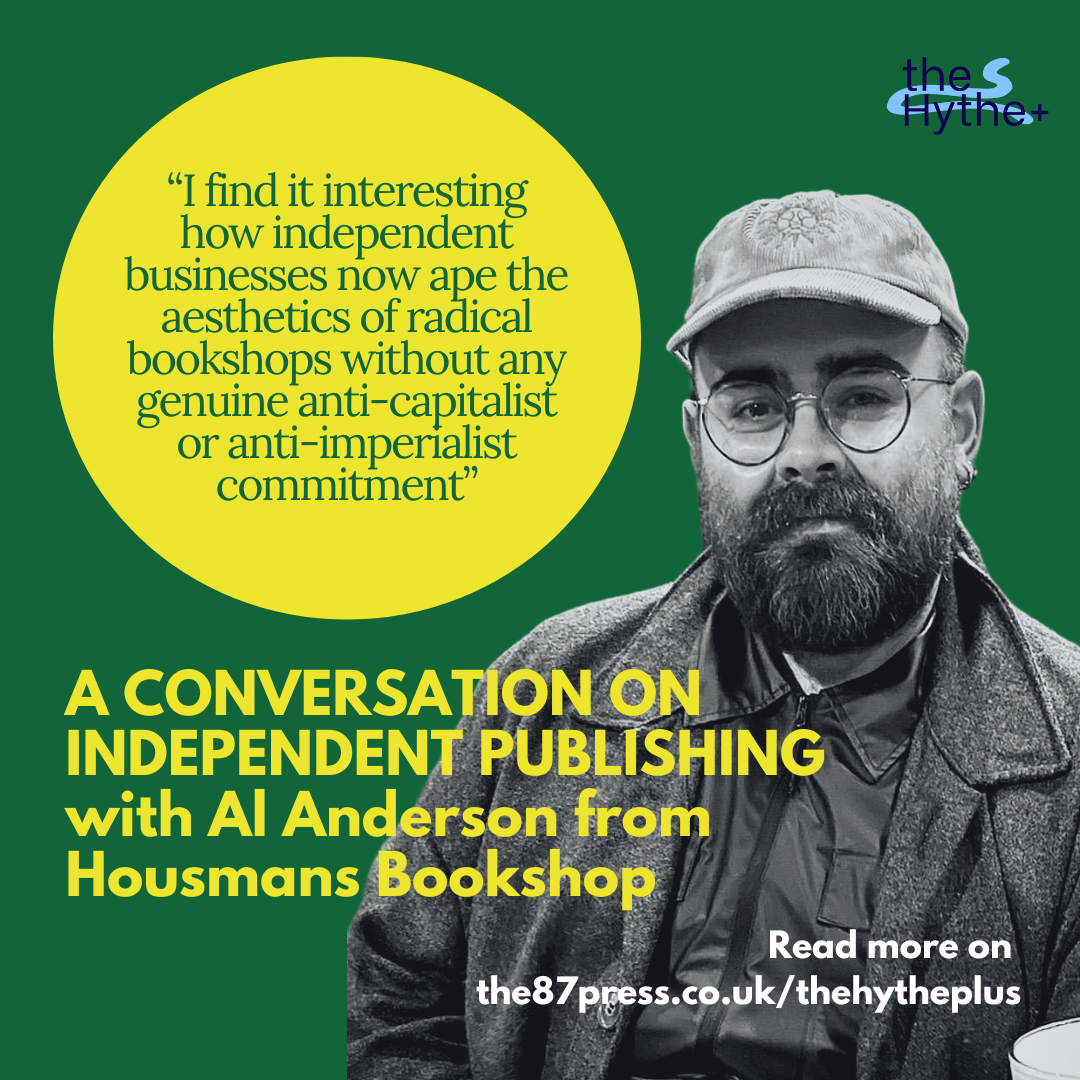
We sit down with Al Anderson from Housmans Bookshop to talk about the history of radical bookselling, the role of poetry in the contemporary left and what community means.
Kashif Sharma-Patel: Perhaps we can start with the bookshop Housmans where you work. It has a proud history as a radical bookshop and I wondered how you compare to independent bookshops? And also where do you diverge and converge with DIY and alternative publishing for instance. These terms often get put together but they have quite different histories.
Al Anderson: Housmans was founded in 1946, as part of the wider pacifist movement that had erupted in the wake of the second world war. It had a small shop front on Shaftesbury Avenue, and then operated as a mail-order service distributing pacifist, gay rights and anarchist literature. It moved to its current site on 5 Caledonian Road in 1959, where it became a shop ‘full time.’ The building, our current home, was acquired by donations from a Reverend, Tom Willis, the kind of Christian committed to a kind of radical, socialist (and obviously pacifist) theology. It is named after Lawrence Housman who was involved in the initial enterprise–brother of AE Housman, the poet–and he was a gay rights activist and pacifist and socialist. The pacifist tendency behind the initial founding and running of Housmans were among those strongly influenced by the non-violence of Mahatma Gandhi (a divisive figure among those of us committed to fighting imperialism today, but whose ideas were very new, and vitally important, to radical formations at the time) and had strong ties to the London Anarchist scene.
When the shop moved to its current site, it drifted away from the Peace Pledge Union, which sort of acted as a central governing committee for pacifists in Britain, and adopted a more radical, explicitly anarchist politics. 5 Callie Rd became an important site for various different radical and activist groups in London. We were the first home for the (UK) Gay Liberation Front and Switchboard as well, who were based in the building for about twenty years. Greenpeace UK was based here for many years too. Mark Ashton, who was an instrumental part of the Pits and Perverts campaign, worked at Housmans in the 80s. A book about Housmans, and 5 Caledonian Road, by the oral historian Rosa Schling came out last year. I highly recommend it, to those interested: https://housmans.com/product/peace-books-freedom-the-secret-history-of-a-radical-london-building/
I think I visited Housmans for the first time around 2012 or 2013, when I first moved to London for university. I started working here in 2022. I was in Norwich doing a PhD in Creative and Critical Writing and desperately missing London, where my boyfriend and most of my friends were. My sister was moving to London for work and asked if I wanted to live with her and I said yes straight away; without sorting myself a job or anything. I started working at Borough Market –which is where I always found work whenever I desperately needed money–and then a job was going at Housmans so I applied. I’d worked as a bookseller for some years elsewhere and was very interested in the political element to the shop… but I applied mainly because I liked the place, I didn't think I was going there to make any radical political change, but as I became more cognizant of the history of the building and just how important it was to the British left there I became very excited to be part of it.
You asked about the relationship between radical bookselling and independent bookselling. There was a time when you couldn't hurl a rock around Kings Cross, Camden or Holborn without smashing the window of some pinko bookstore. There is a long history of independent bookshops which were not explicitly anarchist or communist but were run by such people, who would use the bookshop to fund whatever their respective movement. Central Books, which is now a medium size book distributor, started as the bookshop of the Communist Party of Great Britain.
I think the history of independent bookselling in Britain is strongly linked to radical political movements and formations. This is especially true in London, where it seems you had to be some manner of leftist in order to open an independent bookshop. I am talking about the 60s and 70s, here. There are very few of us left now. There’s Housmans and there’s Freedom Books over in Whitechapel, there is Gays the Word on Marchmont Street, who were founded by people who very explicitly gay and socialist. Housmans and Gays the Word both got raided by the cops in the 1970s under the Obscene Publications Act; we were the only two places you could buy books by William Burroughs or Edmund White or Allen Ginsberg, due to anti-pornography laws. We were easy targets for cops anxious to look like they were doing something useful, such as fighting perversion—they would frequently raid gay bars for the same reason, years after gay sex was nominally legalised.
This leads me to making more polemical remarks. I think today the logic, just described, of the tacitly radical independent bookshop has been privy to a strange reversal. What you see today is a lot of proudly independent (and often mysteriously well funded) places springing up who really promote themselves as being ‘radical’ or perhaps ‘emancipatory’, or even ‘intersectional’ in their politics. What this tends to mean is: a for-profit business deeply indebted to a surface-level engagement with nominally left wing ideas. I think a ‘left wing’ formulated purely through professional-managerial HR speak, social media infographics and a solipsistic, self-infantilising individualism is largely worthless.
I am not saying this because I want to put people down, but because I think it is an interesting phenomenon and think it’s worth discussing. I find it very interesting the way in which even the most radical politics can be fed into a capitalist imaginary and become a market tendency rather than an emancipatory or Marxist politics. There are several bookshops that have opened in the last few years which carefully market themselves as, say, “intersectional” or “community-based”, but will always avoid language like “communist” or “anti-capitalist”. But obviously that moves me to self-interrogation, and provides provocation for our project at Housmans, too. We are a non-profit, but we are a shop that sells literature (and related ephemera) to make money. There is a side of me that would love to give everything away for free, turn a blind eye from people pinching books, just really give the space over community action. I would love to do something as simple as starting a Homework club for local kids. My friend Lotte LS who lives out in Great Yarmouth runs this radical publishing and community initiative called Red Herring Press where they have a shop front. She has homework clubs for local kids and adult education stuff and I would love to do something like that in future at Housmans.
I suppose this is a long-winded, and perhaps vaguely insane, way of expressing some reticence, or discomfort, around the word “independent” as it is used by, and to describe, bookshops. The ‘anarchist bookshop’ and the ‘socialist and/or communist bookshop’ have an explicit meaning that gets abstracted beneath ‘independant’ which is today endowed with a distinct cultural baggage. I find it interesting how independent businesses now ape the aesthetics of radical bookshops without any genuine anti-capitalist or anti-imperialist commitment.
There used to be a bookshop in Camden which closed in 2001 called Compendium. It was a radical bookshop run by a guy who famously also sold heroin out of the shop. It was where you would go as a poet in the 1960s and 70s to get American poetry; it was the only place where you could get Frank O'Hara or Ginsberg or John Ashbery, Amiri Baraka. Apparently Baudrillard once did a book signing there and no one showed up. It was also a site for radical philosophy and one of the few places you could buy books by Derrida, Deleuze, Foucault and Guattari at that time, before those names became more prominent. There was a really good obituary for it when it closed in Radical Philosophy by Philip Derbyshire with this great sentence: “Compendium was the last stand against the commodification of thought.” There are really good catty asides about the degeneration of Camden into squalid Eurotrash tourism, which it always was in my lifetime.
I was thinking about Sara Ahmed's Feminist Killjoy, which is her first trade title I believe. It's one of our bestsellers this year. You see a lot of people with “Feminist Killjoy” on their t-shirts. It had this massive marketing campaign behind it, which I find fascinating for a thinker who sets herself up as the great enemy of ‘white supremacist capitalist heteropatriarchy.’ The amount of money and time put into that book by the world's largest publishing conglomerate would suggest to me that those whom the formulation ‘feminist killjoy' intends to threaten don't feel threatened.
KSP: It is a symptom of the commodification of thought, as you said, and where do you end up. So these bookstores become something else from their origin, or there are new bookstores different to what they claim. I feel like it is related to contemporary art, where the contemporary art world has picked up on these theoretical terms in a way that mainstream literature has not really picked up on these terms and are not really interested in innovative thought or writing. Contemporary art is interested in these things, which is interesting in and of itself, but it does feel deracinating in some way.
AA: There is obviously this ongoing genocide in Gaza committed by the Zionist entity. And yet you go to the Venice Biennale or to a gallery in Mayfair and you see all this language around liberation, the word “Queer” is now so popular that it feels a bit naff – ditto ”ecology”. If you were an alien who was just dropped into a private view in a mainstream London gallery you would encounter a lot of grating jargon, which has a lot of pseudo-liberatory implications in it, but nothing actually tangible or real - you’d be remiss for thinking that there was nothing important or urgent going on in our world.
I think if the ‘art world’ is anything, it’s the bourgeois vanguard. It works to assimilate certain terminologies and vernaculars, which it then deploys to its own ends (invariably with the end goal of generating capital). As you say, the function is to deracinate.
KSP: Even from the 87 press perspective, we have done lots of collaborations and got grants from art institutions; mainstream literary institutions are largely uninterested or do not afford those sort of opportunities to smaller ventures, bar some independent bookshops like yourselves. I find that telling and interesting thinking about the movement and flow of ideas and of capital.
AA: I have been thinking about why the Barbican, ICA and Tate are able to host and engage with difficult anti-imperialist avant garde projects, and I do not think that all the work those places platform is misguided or vacuous. The hegemonic mind, the super-ego of the ruling system, is, by its nature, possessed of this actually quite strange, and perhaps monstrous, earnestness. It is, despite how plainly ugly and awful the results of its labours are, completely and utterly sure of its own moral and intellectual authority at all times. So it’s happy to promote radical ideas because its understanding of them is that no one ever will actually be moved to action (by them). I guess the cultural industry that I’m describing is both a symptom of, and perfectly resembles, that Post-neoliberal, Professional-Managerial mode of Capitalist production. It only understands ‘politics’ as a sequence of empty affects - what it thinks it does is not politics but something it imagines as deeper and more implicitly ‘real’ - the ‘real politics’ is a kind of operating system it charges itself with managing. Anything else, to them, is a callow, adolescent thing.
I have moments at Housmans where I wonder, what are we actually doing with this? Is there a function beyond just existing as a leftist space in Kings Cross? Does there need to be? I’m of course only speaking for myself, here, and not for my fellow workers at Housmans, nor our Board. But there’s something quite hauntological about the place—which I really appreciate. It’s a ghost of the old Callie Rd—which, of course, used to be a red light district, and a very violent, seedy street—and that was the space into which Housmans was opened. Not having a lot of money means we can’t re-decorate a lot. There’s still damage at the front of the shop from a Nazi attack in the 80s. So we’ve become weirdly trendy; precisely because we have not updated our interior decor for 65 years so it reflects a different London, pockets of which still remain, but which are mostly lost.
KSP: One way to read that is that this is living history, a living tradition which we should hold onto dearly, and we do not have to fall into nostalgic retromania to acknowledge its persistent existence. I am sure it will be picked up amongst Tiktok leftists if it hasn't yet!
I am interested in your relationship with poetry and politics, and how that finds expression in Housmans, and following that, how you find the role of the events you run in the wider discourse of literature and culture politics.
AA: I am a poet myself, so I suppose there is a temptation here to lay claim to that dreaded word community and to say that “of course I love putting on poetry for the community”, and “I love enriching the community” and “giving space to poets”. I suppose there is an element of that, but something I struggle with in British poetry is just how radical the differences are between different tendencies; and how the most philistine and aggressively anti-intellectual and cynical tendencies tend to vie for total domination of that shared cultural space. It makes me feel crazy at times. I think people get into poetry with radically different conceptions of what lyric poetry actually is.
When I started working full time at Housmans, and took on the events coordinator role, I was actually quite selfish. By which I mean I take an intuitive approach to booking people to speak at the shop. I read a lot of contemporary critical theory and philosophy as well and I balance out stuff I find personally interesting with the kind of events Housmans has been putting on since time immemorial. It seems to be working, as the events program has been pretty successful. When it comes to booking poetry I’m much more Stalinist–I just use it as space for people I think are good and whose work deserves to be engaged with. I want people who write strong lyric poetry with modernist (or ‘late modernist) sensibilities, who do not write poems because they’re an easy route for self-promotion. And I want work that is ‘political’ in a way that is imaginative and alert. It may sound extremely pompous, but I am really keen to bring in poets who take the form seriously.
I’d say I’m as keen to promote poetics as much as poetry. Independent of my work at Housmans, I’ve held a long term interest in the nature of description, and the human compulsion towards it, towards that impossible task of trying to render the world in language. So I’m almost using the word ‘poetics’ in its original Aristotelian way. I have this quite Derridean interest in the chasm between the description of the thing and the thing in-and-of-itself, and I am really interested in the radical potential of poetics in enunciating cultural despair - that was, broadly speaking, what my PhD was about.
I am interested in poetry as an avant-garde form. I do not know if I have great faith in poetry’s ability to intervene in contemporary culture but it is something that I am experimenting with. Housmans is a broad church and we have a comradely argument here and there. Something I like to argue over is the ‘avant-garde.’ Because it’s something the left has lost sight of and that’s why we always lose, I think.
When I say ‘avant-garde’ I mean the Situationists, yes, and Surrealism etc, but I also mean Black Sabbath, or the sound system culture in Brixton or Handsworth, that was a collective, radical claiming of the commons. When something is successful you don't see it as avant-garde anymore, so the term is a sort of self-negating principle. It just becomes naturalised as part of public life.
KSP: Luke Roberts, in his latest book Living in History, focuses on the failed articulations of late modernist poets and those cultural movements you refer to. LKJ comes out if it perhaps. But we are still living in that general inability to articulate these differing cultural grounds.
AA: I would go as far as to blame the Left in general, especially in the Anglo-American world. At Housmans across the generations you find a general anti-intellectualism, especially among Trotskyists. It’s surprising, and to me seems completely counterintuitive. There is a failure on the left to embrace the avant-garde, insofar as they tend to greet any kind of innovative visual culture or poetics with scorn, at best, and outright hostility at worst. I remember a conversation between Ed Luker and Azad in Spamzine a few years ago where one of them speaks about how the various left-wing media organizations that have risen to prominence in the past decade have done so by aping the aesthetics of bourgeois culture and rejecting the more vanguardist, weird and queer tendencies, that have emerged around them.
KSP: It did feel around the student protest times of 2010 through to around 2015 that there was a larger aesthetic imagination forming, when a more general autonomist tendency was taking hold and questions of 1968 and the 1970s were being revisited. And then Corbyn happened and it all got pulled back into a very dry social democratic imaginary.
AA: Absolutely. Backing and uniting around Corbyn, as I did, really was the death of the radical imaginary. It may be controversial to say, but that was the real death of the radical left in many ways. I have met Corbyn a number of times, he comes into the shop all the time and he is a lovely man. But I do think the culture around him was destructive to the wider left.
That takes me back to that word ‘community’ and why it makes me feel uncomfortable, because to evoke the ‘community’, rather the commune, you are automatically foreclosing something, you are erecting a fence around you. It is so often evoked as a self-serving mechanism which is what I was alluding to earlier. It is so often gesturing towards a wider communitarian politics when it is in fact not doing that at all. It is almost a word that serves to subdue collective movement.
KSP: I know you are interested in journals as well as theoretical discourse. How do you frame and balance those interests against bounded poetry books? And thinking about the different communities being generated through the page or online.
AA: Firstly, thinking about poetry and theory: a consumer habit I have observed over the past two years at Housmans is that there is a tremendous appetite for philosophy and theory among younger people. Mark Fisher is hugely popular, and other similar writers like Owen Hatherley, Richard Seymour and so on. This year, for obvious reasons, Edward Said and Frantz Fanon (two subtly different thinkers, in practise) have been hugely, hugely popular.
It is interesting that poetry has not appeared to have accumulated that sort of interest in the same way. And the people who would constitute what I guess we could call the ‘mainstream’ of poetry are not the type of people who are interested in philosophy. I almost see Sean Bonney as this lost link between those worlds of late modernist poetry and contemporary left-wing thought. He is my favourite writer in that mode. Mark Fisher was a lecturer in my department at university and was hugely important to me and many others (this is all very well documented, obviously.) He was a brilliant man and his work only gets more important. It’s heartbreaking that most of his fame is posthumous (he was also a far more divisive figure—at least at that time, in that university, than people choose to remember.) But there was something about Bonney’s work when I first encountered it that struck at something much deeper in me—a place I tended to think of as beyond ‘the political’, that had only been touched by the likes of T.S. Eliot or Frank O’Hara before. Something about that epistolary mode he adopted later on, that was so uncompromising, yet dialectical. It just had so much more force than any theory I was reading. Sometimes he reads like this constantly unfurling reprobate, but sometimes he reads like one of the Church Fathers. There was something tacitly theological in his writing, I think. Unerringly eschatological; but that’s still reckoning with God. I just find it really convincing. His latest collection Our Death has actually gone out of print so I can’t get copies into the bookshop. Which sucks.
The best poetry journals are mainly the online ones these days. Not to be too praise-y, but what you do with the Hythe is great. You never miss. I loved that essay by Keston Sutherland you published a while back. And great poetry always. Physical journals dont sell that well. The ones that do sell have a good online presence already. However I did an event with Ludd Gang for their Ill Pips anthology and that did really well, and the little poetry zines tend to do well. The ephemeral nature of both the zine and online journal gives more freedom and thus more interesting work tends to be appearing. There is also a lot of terrible stuff as well of course, and because of the hyper-abundance of online content it becomes very hard to find new things you can trust. You do still need to know people to find out new stuff that also worth reading.
I have noticed that instead of people starting literary journals that have been pamphlet programmes instead. The Earthbound series is probably something people will know, for instance. Instead of doing a magazine with ten poets you just release a tiny pamphlet. The cynical reading is that that just speaks to how atomised and superficial everything has become, because rather than having a collective tome you have these monolithic individual pamphlets. But I actually find it a more interesting way of getting people to read poetry. It can have this old-school anarchist anti-aesthetic tendency. I used to co-edit a zine called Pigs with my friend Hannah Levene which had this old school photocopied style. It was deliberately ugly.
KSP: For sure, so there is a third space being developed between the DIY zine and the more formal book. Even what Rob Kiely and co are doing at Veer2 also sits in this nether-region, even if they are bounded books, as they operate as a series of writers from the same circuit. A positive reading is this is a laboratory, a closed-off space largely, and could be a vanguard perhaps. Though I am not convinced it is.
AA: I want to talk about a poetry reading we hosted recently with Nat Raha for her latest collection nines which was published by the brilliant US-based small press Nighboat. I dont always enjoy poetry readings – Alice Notley famously referred to them as hell. I often feel bored, but not at that one. Nat is a very brilliant performer and she is very good at writing work that is nominally quite inaccessible in the sense that is conceptually very sophisticated, but she is able to perform it in a way that makes it feel brilliant and vital and alert. It was just one of those busy readings that felt like a party. I still don't feel like that was where the revolution was birthed, though it was certainly closer than some other poetry readings I have been to over the years. We are doing another one with Amy De’Ath and I feel like those poets– Amy, Nat, Luke Roberts also–are actually really vital figures. Not to be too gushing. It is weird we dont have a name for that group of poets I’m thinking of, like Rob Kiely, Ed Luker, James Goodwin, Danny Hayward and so on. The problem with poets is that we are immensely self-conscious; no one wants to go: “WE ARE the movement, WE ARE the post-marxist modernists” or “The London Autonomist Poets” because it obviously feels cringe. But it might be useful to an outsider—like I was for many years—who is interested in poetry but feels utterly alienated by the miserable hell of ‘spoken word’ and slightly disgusted by the ‘Faber School’ with its twee cronyism, pastelle colour palettes and that grating, flat affect they all write in.
*
Al Anderson is a writer, critic and bookseller based in London. He recently completed a PhD at the University of East Anglia in Creative and Critical Writing, about ekphrasis, devotion, artifice and the cultural formulation of the 'self' within contempoary literary and visual cultures, focusing in particular on 'confessional' modes. A small collection of his poetry was published by Blush lit in 2021, called ‘Tenderloin’. He is currently re-working his PhD thesis for publication and also working on a novel about a man in his thirties who comes to believe he is a re-incarnated John the Baptist and founds a radical ministry in the English Midlands.