
“We believe that the ancestors whisper to us, and perhaps the ancestors were whispering to me when I wrote these poems” : An Interview with Juana Iris Goergen and Silvia R. Tandeciarz
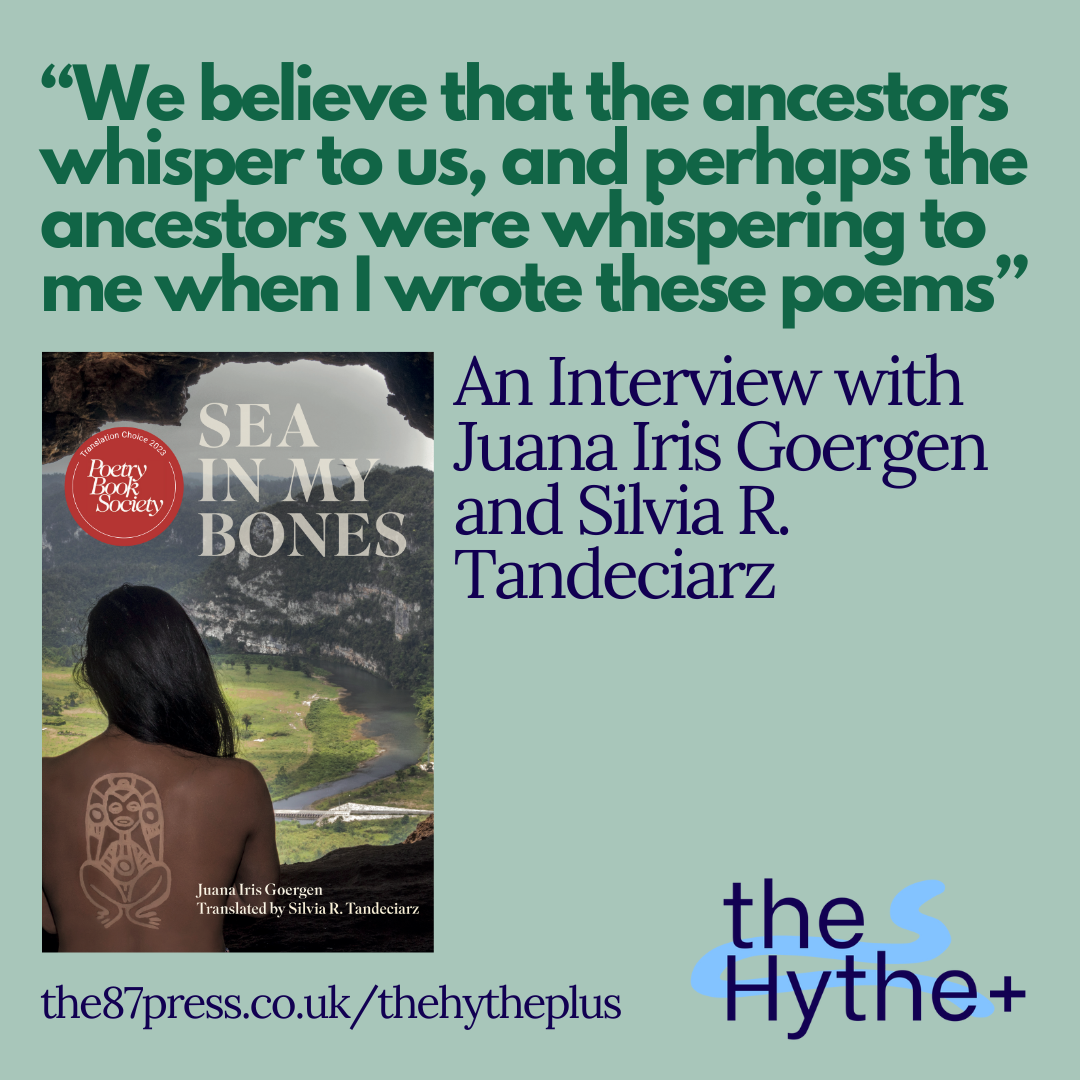
Juana Goergen’s Sea in my Bones was published by the87Press in 2023 and translated by Silvia Tandeciarz from Spanish to English. In the following conversation I sit down with both writer and translator where we discuss the trilingual nature of the book — Spanish, Taino and Yoruba — the embodied history of the Caribbean and the importance of myth, memory and ritual. I begin by asking Juana about the influences on writing the book.
Juana Goergen: You made me think of the why, the reason behind the collection of poems. I always say the book started from the epilogue of the book. It is really the first poem that I wrote for the book with that title Sea in My Bones. I wrote this poem for my children because I was sick and because I was afraid that something might happen to me. So I wrote it and left it there. Then came this DNA project from my friend, a German-Swiss geneticist who was doing a study in the Caribbean. He asked me for genetic material which I gave. It was not a surprise that there were African elements in there, but it was a surprise that there was an Indigenous element in there. I felt it was something I should write about, so I returned to that poem I had put away and continued to write more poems on that theme. That is the usual reason I give for the origin of the book.
But this time, when you asked me this question and asked me about my influences, I realised that sometimes there are dormant places inside the psyche or inside the soul, and somehow they come out. There are poems about African women and Indigenous women. The book I had in the back of my mind was Omeros by Derek Walcott. I came to my first professional academic job the year after Derek Walcott won the Nobel prize [1992], so I revisited Omeros. It impressed me that this 300-something page book was poetry, and that it had received the prize. Out of the whole book the conversation between Pinkham and the Iguana stayed with me, when they were discussing who created the Caribbean and why colonialism was permitted in these lands. The fact that a poet had placed an iguana in a very serious political discussion with a military man was striking. It was a very serious discussion about the myth of the Caribbean. Derek Walcott was somehow inside of me when I wrote these poems, pushing me further to listen to the voice of the ancestors. We are superstitious in the Caribbean. We believe that the ancestors whisper to us, and perhaps the ancestors were whispering to me when I wrote these poems. If it sounds poetic, so be it.
Kashif Sharma-Patel: Finding that genetic link gave you the impetus to continue that train of thought that focused on the indigenous roots of your work, through history and folklore. Is that correct?
JG: The novel The Deep Rivers [by José Maria Arguedas] bases itself on the deep rivers that run in our blood, and how those rivers make their way to our voice, our minds. In the Caribbean we do not mention the Indigenous voices enough. Everyone says the Taíno died in the seventeenth century and that was the end. I wanted to give voice to those voices. In other islands blackness is very present. In Puerto Rico we obscure blackness, we say everybody is black. So when I call my husband negro I mean my darling. We have assigned positive connotations to a word that is clearly a racist word in other places. But we have plenty of people who are Afro-Puerto Rican who are being erased. My friend Mayra Santos is at the University of Puerto Rico directing African diaspora research, and she says that for a long time they erased my identity, my colour. She said she could not see herself as an African descendant as they had erased that narrative. I wanted to give voice to those voices also.
Silvia Tandeciarz: I want to return to Derek Walcott for a second. The first poem that I translated of Juana’s work was called ‘Reconquista’ – reconquest – where she is speaking to Walt Whitman. I always understood Whitman as the voice of the United States of America, the voice of this nation, but not the Americas as whole. Juana explores the meaning of being colonised within this land that Whitman dreams contains multitudes. There is a direct link between being a colonised woman living in Chicago at that time – in the land of Walt Whitman – and trying to speak back, reclaim a voice, decolonise the self. A similar impulse drives the collection here, Sea in My Bones. It is a way of saying “we tell our stories”, “we have a story”, “there are other voices”. It is speaking back against empire through an act of creative imagination that is so necessary in the present.
I felt it important to bring Juana’s work to an English-speaking audience as a way of amplifying and enabling the poet to speak back, from that neocolonial subject-position. The act of translation is an act in solidarity, a decolonising act. This is a continuation of that work we began much earlier.
KSP: At what point did you two become acquainted? It is interesting how your relationship has developed into a wider dialogue which seems very fruitful, encapsulating the ideas of translation and decoloniality you have touched upon.
ST: Juana was part of the search committee that gave me my first academic position at DePaul university in 1996. I was a brand new assistant professor and Juana had just gotten tenure.
JG: Exactly! I knew Silvia as a poet through her CV. There is a kinship with other poets when you come across them. You know in your heart of hearts that that person will read you well, as a person and a poet. But when I met Silvia she was also on a project of translating philosophy, the works of Chilean Nelly Richard. I thought how interesting, a poet translating a philosopher, and we became friends. When Silvia translated ‘Reconquista’, I realised I had never trusted translators. Poetry in translation, for me, was colourless. The specific images and metaphors were never adequately translated to the other language. I never found that translation could read my soul, my intention, my poems. When Silvia began the translation it was different.
Other people have translated my work. Their translations are faultless, grammatically, but the soul is not there. I found the poems dry. I am very grateful to Silvia, and I always try to send the poems to her first as I write them. I also trust her voice as a critic, as somebody who can steer me in the correct direction with the poems, too. I would like you to tell me your process, Silvia, of translation and reading. I do not know your inner process!
ST: Juana orchestrated poetry readings at DePaul for the academic community and the broader Latino community in Chicago, and those readings grew into a very important festival that now happens every year in April. I was only at DePaul for three years before I came to William and Mary, but those three years were so formative for me. Juana invited me early on to read my poetry, but it was hearing her read her own poetry at that event that was really transformative for me. It was so important for me to capture her voice, that oral quality, in the translation of the poetry after seeing her perform it. It was not enough just to see the words on the page. I would not have embarked on the translation project had I only seen Juana’s work on the page. It was hearing her, and then trying to honour that voice in the translation [that drove me]. I also had to amplify her. The audience that speaks Spanish is important, but she is speaking to so many other people who do not have the Spanish skills. I felt it at the core that I had to do this. It didn't feel like a choice. This is about why we engage with the work that we do in the first place, and what matters to us. From my perspective as a translator, they were my political, cultural and intellectual convictions that drove me, and they were the messages that were contained in her poetry, as well as her voice, that I wanted to amplify.
KSP: That leads me quite nicely to that question about sound Juana, and the importance of sound and rhythm on the page and in performance. Of course in the book you have these other languages displayed – Taino, Yoruba – which are not translated for either an English or Spanish speaking audience. So I sit there speaking the words, making sense through the sound and rhythm of these foreign lines which heightened those aspects.
JG: I grew up in continental Latin America, in Colombia - a vast country which has an outlet to the sea on the northern coast. I also grew up in Uruguay, which is also a continental land. I came to study my undergraduate degree after moving from Uruguay to Puerto Rico. In the first year of my degree they invited a poet from Barbados, Edward Kamau Brathwaite. Everybody else was reading from their books, but then came Braithwaite, who came out and started tapping rhythms like the drums. His reading was unforgettable at a time when it was unfashionable to really perform in that way. The poem had one verse that stayed with me where he said: “it is not enough to be free from diseases, boots and invasions”. He was talking to us in Puerto Rico of course. He was telling us that the colonial situation vis-a-vis the US may shelter you from diseases and from invasions or the military boots as they are already here [but you are not free].
I had written a few poems already in the style of a Uruguayan poet named Marosa de Giorgio. She is a very lyrical poet. But when I heard Brathwaite, in my heart of hearts I understood that that was what I wanted to do. The rhythm comes from my roots, the music that always surrounds you in the Caribbean islands. The loud voices and living feeling that you find there. In London, we found something similar in Dalston where we were staying. You have the sound and the voices and the people in the markets! That is what you have in the Caribbean. A poet is a recorder, a rememberer of their culture, or the culture that they love. It was not my intention, but those rhythms got inside of me. After Braithwaite I started sounding my poems. I know friends that just write but I say the words and if it does not sound right I change the sounds. It is sound and pen, rather than mind and pen.
I realised you cannot talk about myth or used borrowed languages from the Indigenous Arawak without incorporating their rhythm because their language has such a quality. In the Caribbean we lost the Indigenous element more than in other parts of Latin America. They have disappeared as people. Only in Dominica there is a tribe of the Caribs still alive and thriving, but they thrive as Garifuna, a mix of the indigenous and African rather than the autochthonous peoples of that Taino-Arawak. So I wanted to use their words. A professor at the university of Puerto Rico whose dictionary I use for this book and whom I give credits is Dr. Edwin Miner Solá. He said once: “I write this dictionary, not because I know a lot of the words, not because I have strong contact with this language, but because Western Civilization has not let Latin die.” Even though we say Latin is dead we still use it in church, in medicine and so on. In the Caribbean the little of Arawak has survived via the latinization of the words like Juracán, Hamaca (Hurricane, Hammock). These words are Arawak words, but they survive via the Latinization of the word which then passes to English and onwards. I wanted to be faithful to the voices of the ancestors. That is why I decided that to preserve their memory I would preserve it through their language. Their language is their memory. I do not think that I had an intention to do that really. The second poem was the original story, the first poem [I/ Ku]. We know the word caracol, but the word was caracaracol in Arawak, so I understood I would have to use that original version. Once I did that, I started to look at the words more carefully: I wanted to say manati, but that is the Spanish word, so I used esterei tei. That different voice really resonated with me. I did this with the indigenous people and with Africans too. African words often survive via our food: mofongo for instance. I wanted to recapture Yoruba. In the centre of the island, a ritual of death, particularly when a child died, they do something called Bakiné. It is a ritual which sends the soul of the child back to Africa, back to Guinea. So they sing a song in Yoruba, even though they do not know the language. They put flowers down and sing. I thought if I do justice to Indigenous people I will also do justice to the African ancestors. That is the origin of rhythm and bilingualism or trilingualism in the book.
Of course I was not thinking of translations of this book. I thought it would be impossible to translate this book considering it incorporates the Spanish psyche and composition of the language but also the fluidity from Spanish to Arawak and Yoruba which is quite unique. Silvia, what was the experience like of incorporating those languages along with the Spanish.
ST: In some ways it was simple because my task was to render your Spanish into English, and leave the rest alone. Because that is honouring those voices. A Spanish speaker doesn't know Arawak or Yoruba, and yet the text speaks to a Spanish speaker and I wanted to make sure that it also spoke to the monolingual English speaker. My task was in some ways much simpler than yours. We did go back and forth because I had to understand an image or a metaphor to make sure I was getting it right. It is almost like there is a skeleton of these other languages propping up the Spanish and propping up the English. The lyricism needed to adapt to that skeleton. I always think of translation as the most fun creative process. You get to play dress up, you get to inhabit someone else's world and figure out how to shapeshift into that.
JG: I am grateful that it was dressing up for you, and not overly professional, because at my last year at DePaul there was a tribute to the poetry festival where I was honoured. They had translated two of the poems for that particular tribute. They took translation as a profession, the art of translation. They gave me the poems a few hours before the event and the translator they hired had eliminated the words in Yoruba and Arawak Taino. This was totally against my purpose. They were working, not dressing up. In the reading I incorporated the words as they should be, but it made me think of Neruda and poets of the twentieth century who would refer to the translator as a traitor. Una traductora es una traidora: a translator is a traitor. Neruda was adamant about checking his translations, because he was convinced the translator was a traitor. This is how I felt when I saw these translations; my intention is no longer here.
You always ask, Silvia, whether you understood correctly, and I appreciate it greatly. That is very important in translation. I want people to see the colonial terms can be read against themselves, and I am grateful Silvia takes the time to understand my specific words and their context.
KSP: I studied Spanish in school, however we learnt European Spanish – Castilian – and it is interesting that through my experience travelling and reading, the Indigenous elements and sounds that creep into Latin American Spanish(es) are very noticeable to me. And that became very clear when reading Sea in My Bones also, there are sounds that are recognisable as belonging to that land, that culture.
ST: I also grew up between Latin America and the US, so my ear is attuned to the different Spanishes spoken over here. I learnt English when I was 6 years old, Spanish is my mother tongue. But I also spent time in Ecuador and Uruguay, and I have cousins in Mexico, so I move back and forth. My own personal history of living between languages gave me an ability to pay attention to those tonalities and rhythms, the differences that are pronounced. It is Spanish, but it is a different kind of Spanish. It sounds different and you have to honour that.
In terms of my own trajectory, living in the US means I spend my time mostly in English, but I also work with students who are often heritage speakers of Spanish or learning Spanish, and in my extended Spanish-language community surrounds me. I have taught border theories and ideas like tropicalisation of language, where an author will write I have sleepy instead of I am sleepy (from the Spanish ‘tengo sueño’). Translating the Spanish in this way, so abuelito becomes my little grandfather, is a way of inflecting the English with the Spanish, a detail the Spanish-speaker can capture in a way the English monolingual reader might not get. What sounds strange to the English-only audience (I have sleepy) makes sense to the bilingual community who understand the cultural codes being referenced. Being attentive to those small details is important for my work in translation. And it is a gift to be working with somebody who is willing to get on a video call or the phone to answer your questions. Translators often work in a vacuum without access to the original writer, so having Juana at the other end of the line is just a dream come true.
JG: It is most important that a translator is faithful to the core of the collection, and not just the words. Not everybody is a privileged reader, not everybody can read the Spanish, let the Spanish live in their head and also read the English. If the translator translated Tengo Sueno, as I have sleep, that would be wrong! It is just an idiomatic expression. The reading process is also an interesting process. Who will the reader be? A person who has knowledge of the original language or a person wholly dependent on the translation? If that is the case then it is no longer my book. I think the prize in England is really your prize Silvia [The Poetry Book Society Translation Choice 2023], as you made the reader understand the core of the collection. That is the beauty that you cannot find in every translation.
You can order a copy of Sea in My Bones here.
*
Juana Iris Goergen (Puerto Rico.) Has published: La sal de las brujas in 1997, La piel a medias in 2001, Las ilusas en 2008 and Mar en los huesos in 2018. She has edited eight poetry anthologies, such as: Susurros para disipar las sombras, Rapsodia de los sentidos and Ciudad Cien. She initiated and co-organized for eleven years (together with Chicago Cultural Organization ‘contratiempo’) the International Poetry Festival in Spanish, Poesía en Abril. She has received the awards, contratiempo/cultura in 2013 and Premio José Revueltas de poesía in 2017. An international poetry award, Premio de poesía Juana Goergen, has been created in her name since 2019. She has two unpublished poetry manuscripts, Las celdas de Iris and Este nuestro nosotras. Mar en los huesos/Sea in my Bones has been published in translation by Silvia Tandeciarz with 87Press in London 2023. Her translation has been awarded book of the year in London.
Silvia R. Tandeciarz (Modern Languages & Literatures and Global Studies) is Vice-Dean for Social Sciences and Interdisciplinary Studies at William & Mary university. Professor Tandeciarz obtained her Ph.D. from The Literature Program at Duke University. A specialist in Latin American Cultural Studies criticism, she is particularly interested in the role memory plays in advancing democracy and human rights in post-conflict settings. She has published widely on contemporary visual, spatial, and performative cultural initiatives in Argentina that serve to process and transmit traumatic memories of the last dictatorship and is the author of a monograph on this topic. As an extension of her research interests, Professor Tandeciarz has partnered with scholars, activists, and practitioners in the United States and abroad to offer students signature opportunities highlighting the privileges and responsibilities of global citizenship. These include the National Security Archive Research Internship; a Field Research in Human Rights Winter Program in Argentina; and a summer Human Rights Intern Fellowship in Argentina. Her substantial service has included administrative appointments as Department Chair of Modern Languages & Literatures; Interim Dean for Educational Policy; and co-chair of the Academic Initiatives Task Force, 100 Years of Coeducation @ William & Mary. Her recognitions at W&M include the Thomas Jefferson Award, A&S Award for Faculty Governance, PBK Faculty Award for Excellence in Teaching, Plumeri Award for Faculty Excellence, and the Jennifer and Devin Murphy Faculty Award for outstanding integration of research with teaching.