
Hythe+ #9 Sky-Blue by John Wilkinson
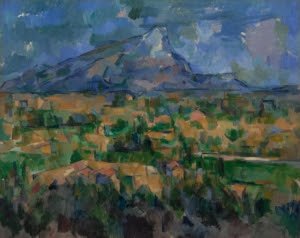
P. Cézanne, Mont Sainte-Victoire, 1902-1904, oil on canvas, Philadelphia Museum of Art, Philadelphia
One of Paul Cezanne’s late Mont St Victoire paintings divides horizontally between a top third, where a blue-cast Mt St Victoire looks disconcertingly like a recumbent ceiling-gazing head, up-tilted nose, some Philip Guston caricature of the painter supine; and a lower two thirds whose division from the sky-blue swirling above, by virtue of its bright green, cobalt, red and ochre palette and blocky paintwork, is so absolute that the eye finds it difficult to accommodate either to a sense of depth, tracking through a complicated landscape towards the foot of Mont St Victoire, or to the contrary impression of a blind of multi-coloured fabric, whose flatness or pattern of shallow tiling points towards the painting of a half-century later, Mark Tobey or early Mondrian perhaps. Something has been lost in a pocket of space or time which clarity of perspective might yet bring to light. If only distance could be established, a silhouette conceivably might flesh out, or a furtive figure reduce to a silhouette of little significance, in a merciful enfeebling.
As it now presents, this canvas is reminiscent of a hidden object-game or drawing (‘Where’s Waldo’, for example), but no slippery character can be homed in upon, leaving space for the thought there may lurk a multiplicity whose concealment represents just one missing and determinative figure. Understand this character as if dispersed between undescried pavement ants in tiling cracks or clothes moths in seams, acting in its stead – swarms of decoys whose presence is felt but cannot be captured –, a multiple integrity carrying forward its ceaseless and subversive work. Perhaps someone or thing, something or one in me doesn’t want to contemplate.
Dream admits no depth of field. Geometric rooms may have been tidied before my occupancy and sanitised, but are occupied by a missing string of seeds, rosary of emptiness; indeed, the missing pervades and even becomes assertive, more so than the considerate amenities – nothing to the missing – presenting themselves only once an automatic gesture fills their outlines, at the instant of use. Flashes on the margin of the visual field, purr of an air conditioner – you reach for the touch pad, adjust. Nor do these rooms (for there is no ‘those’ in dream) offer to contain the missing whose sway laps down to a distant pine-fringed beach, folding in various fruit (notably a roseate pear), civic edifices and a refinery’s stacks, also embracing a flat gold angel rounding into a fully-fleshed female nude, a half-hearted rainbow, a boat’s bleached ribs, and the name Hubert Beeswax. A tablecloth decides to curtain. A curtain decides to billow. A ground decides to foreground. A foreground decides to saturate with loss. Loss gives you more, a hoarding proclaims in your face or on a far promontory, clicking between vertiginous depths and almost touchable blanks, missing the mid-point, prodigiously.
This missing middle-distance placeholder, accords with time as much as space. Fleeting minutes butterfly elaborately about the tarry lump of a lifespan shaped by a stupid autobiographer, yourself; and your loved creatures, people and places, become anecdotal, or a set of gestures recurrent as earworms, scraps of handwriting at the back of a drawer, regulating all that clocks might do. All the songs of youth connive to distract from a lost, loved voice. They halt for you and at a signal resume; ‘a network | of simultaneous points | trawls us into place’ wrote Tom Raworth in ‘West Wind’. Hasn’t this polarity of painting and viewer, of stuff and consciousness, now completed an about-turn? Was the furtive figure the viewer himself, chasing his own shadow across algae-splashed rocks, distraught in search of a coign where it might enrobe in flesh, just for a moment – but it was too much, too many, in tide-loud gullies, behind a boathouse... In a clean and well-lit room where lost seeds float everywhere and nowhere, Tom Raworth captured impressions and let them flutter free across pages, across screens, and Tom is still ubiquitous, his reticent presence more pervasive than anything instruments might capture, poor gadgets fated to arrive too late on the scene – Tom’s grab-shots seem to have triggered their camera’s action, quick as his thought or even anticipating it.
Flickering is an apt description for Tom’s poetry and his company, a quicksilver unity of attention and distraction. Reading his long poems is to experience an intellective equivalent to flashes on the periphery of the visual field, starting to constellate as ‘a network | of simultaneous points’, with interference from the mental equivalent of optical floaters. The brick of Raworth’s Collected Poems cannot immobilise, cannot contain its contents, any more than the grid of a Raworth collage can pin down the squirm of the tiny, intricate visual frames it organises, as though the frames of a Stan Brakhage short were displayed in a temporality collapsed into one flickering light – but there is always more going on than the conspective glance can reveal. Visual passage across the present collage (above my desk) reveals tiny labouring figures behind starbursts, collaborating in their ant-like diligence to construct a brilliantly-coloured landscape lit up at the back of the retina, or maybe telescoped from a distant future, at the same time making this-here: ‘a network | of simultaneous points | trawls us into place’.[1] What place, if time and space present to the jumpy eye as fractal, either a kind of paisley shawl or allowing insight into the means of production?
Went Swimmingly
for Tom Raworth
Shiver of water flowers
on the lake and diminishes.
Crickets shiver in the
pooled air.
Spirit is a bone
spirit is a gland,
stack of pine cone tongues.
A whatnot having seeds
sublingual, can release,
the whole lot flip
up like tiles, spelling out
recurrent names,
all their ways were obtuse
until the west wind blew.
All books have departed from this stripped loft, thousands of them, but Tom Raworth’s books haunt (haunt, which means a present absence) a space devoid of the soft furnishings that absorb light; a space haunted especially by his Common Sense, aptly published by Zephyrus Image, O wild West Wind, whose zephyry leaves in their diminutive spiral-bound reporter notebook format ‘flip | up like tiles’. The light both direct and bouncing off the window ranks of the Donoghue building opposite me in Printers Row, is so harsh I must pull down the blinds. It is hard to focus on the computer monitor owning to the shadow reflection I cast, in the middle depth behind what I type and before the glowing gold rectangles of the window blinds. My ghostly image is a floater in my field of vision. Today is the two hundredth anniversary of the death of Percy Shelley, but not a breath stirs. Stagflation is the term being applied (again) by journalists to the state of the economy, a stagnant inflation, and as my eyes seek to adjust, my image too is bloated and becalmed. O Wind, the cursor blinks and stutters across my face’s fenestrated shadow of a possible singularity. Four volumes of Shelley printed at the Florence Press, the first books I bought as a child at a second-hand bookshop, spending every penny I had, unable to resist the beauty of their paper and typography – those too have departed. What does it mean, to be thrown back on your own resources, if your resources lie shadowy between screens and blinds, once books and poems have been cast to the winds?
Tom Raworth’s attention was the most sensitive of conscious surfaces. His eventuating poems never contract into muscular unity, but ripple and flicker – for Tom, time was light, as he once told me, a shifting honeycomb like a lake’s surface not quite calm but not agitated either. Bubble-unwrap. I turn up, in packing my effects, a letter so consequential that I had managed to forget its existence; perhaps I could not bear to read it when I received it in my late teens, and now I look at the handwriting and the first line and can read no further into the little stack of thin notepaper. It belongs to a vague world pocked by burial sites of material. The disfigured face, gentle Reader, wherewith this worke not long since appeared, is mine, not the corrected version I submit to the world. The tucks and pockets holding evidence, a green file, a scrubby hillside outside Birmingham, a taste ghosting my mouth from under the floorboards of a dormitory, a reckless purchase, these comprise the network, the flashes of light that continue to trawl me into place. Or is it the reverse effect, and the material deposited, acts as a decoy to quench any flicker of light, the brilliant honeycomb a charnel field; but search through those deposits for one of my kidneys, in that ossuary for a spatchcocked ribcage, and when all components are assembled, will they compel an immediate blinding light, heralding some freak resurrection, an exquisite corpse summoning in turn a reluctant and vacant-minded god?
Ecce homo, or his negative, his cast. Not the disappearance but a ceaseless, repetitive act of departure. It is impossible either to turn away or turn inward, averse. Departure is a detention, I am ‘in detention’ because departure never is conclusive. Here I go again. This pleading, this reproach, racks me with the uttermost, agonised plea to encompass an eternity in a look; it is that, yes, not the work of Donne’s lovers, but life itself situated as a middling suspension in the moment of death, eluding focus. Not a thread but an orb, a standstill between systole and diastole, between two, who might be one mirrored, no other here, that’s how it is too frequently. But in this instance, not double-one his own. What sustains and excruciates me is my dying sister’s detaining scrutiny. Did this look implore me to hold her, hold her back here? Was this look begging me to accompany her over the threshold? Where was I, where am I in that moment before turning to walk away? Suspended in an orb of seeing with no object, nothing to be seen, nothing knowable, time without extension – but what is time without extension?
Cross the threshold with me, is that her plea once and for all time? Bring me back across this threshold? Stay always with me on this threshold? Wittgenstein: Death is not an event in life. We do not live through it in the world. If eternity is understood not as infinite temporal duration, but as non-temporality, then one can say that he lives eternally who lives in the present. But by that light a gambler has been granted eternal life; by that light, eternal life awaits the reader of Tom Raworth’s Writing. By that light, absence and presence resolve into an orb of that light.
By that light, the muteness of objects offends. Even as curtains shift they thicken in their obduracy. Chairs remember nothing. The tabletop fails to respond to papers gaining mass despite the writing of alleviation. As evening comes, objects settle into themselves. They will not be available, or other, there will be no habitant of these antiseptic rooms seeing too much – to see too much is to cease to nest in habitual seeing, switching on the light, drawing the curtains. Mont St Victoire, a placeholder against sky-blue, resolves to a non-functional lump of rock and soil, or to ground pigment and canvas.
The wind’s gusts flap and rattle the part-built condo a street away, dispersing singing insects, hidden band of crickets. With all construction paused for the weekend at peril of carpentry flying apart, just such agitation brings me to a sense of self, produced out of recalls bounced across decades, a sequence of recalls, stitches in time that mobilise some feeling of, if not a coherent, at least a consecutive, a serial self, but invisible to others, and at odds with the dirty encrypted material, pockets of guilt and omission. At odds too, so I imagine, with others’ perspectival other-self-fixing of one, simultaneous points of view trained upon one, their view of one so wrapped up in himself as he goes. And in truth it is that outer wrapping where integrity gets located, while the consecutive self-construction, paused for now, retreats into a precedent for precedence, a fantasised integrity prior to subsequent scatter. Drawings consulted on site. O wild West Wind, this wild weather destroys and preserves.
Under the Birmingham city street, in underground passages with their niches stacked with bone now accessible to the curious, a small and repeatedly vanishing creature of integrity scuttles, enticing, repellent, dangerous. In seeming to go back a level you find yourself moving forward to a point where your present thin flicker is beckoned into unity with an imagined origin, a tarry lump, a placeholder against sky-blue, “sentenced he gives a shape” as ‘Tom Raworth’ still writes, sentenced to no resting place ever.
…..
The foregoing writing was set down in Chicago, ‘in a haze of nerve-gas’ before departure:
in a haze of nerve-gas
he fell backwards in pure reflex
drifted down the access tube
full of references
altered to magnify
a feeling of rightness
abstract patterns shifting
into jagged vertical tattoos
whirling the line through long arcs
learning to adjust
the way flames leapt
in all that magnificence
into flashing monochrome images
created in his wake
whereas the stanza reproduced above was written by Tom Raworth, peerless magician of “flashing monochrome images”, comprising the final section of his inextinguishable ‘Eternal Sections’. The poem may have been written in the very house in Cambridge where now (a different now) I take up these threads and from their references and attachments, their elusive figures, seek to arrive at a feeling of rightness. Raworth’s ‘access tube’ may be television, a computer monitor, or the human receptor-consciousness constellated as Tom Raworth. Tom Raworth’s writing undoes, conclusively, any idea that writing emerges out of blankness, out of whiteness; even that stray phrase whose rhythm might set one off, out of one’s one-ness, or that notion drifting into mind during routine work, arises from dream-trails or wriggles free of what filters the sensory inundation, as Mont St Victoire lifts out of an active pleating, the ripple of landscape elements – roofs and trees; and magnified, recurrent from canvas to canvas, decides the feeling of rightness in paintings that anticipate abstraction.
You must lose something of value to compose yourself; red roofs lodging in vegetal folds in middle distance, a tchotchke whose loss fills a room, a troubling memory dispersed into life-long pinpricks of guilt or eyelid twitches. Mont St Victoire arises, of necessity, and Tom Raworth’s poems reconfigure space and time, through all the length of them, the speed of them, while memories of Tom flicker at the margins of recall.
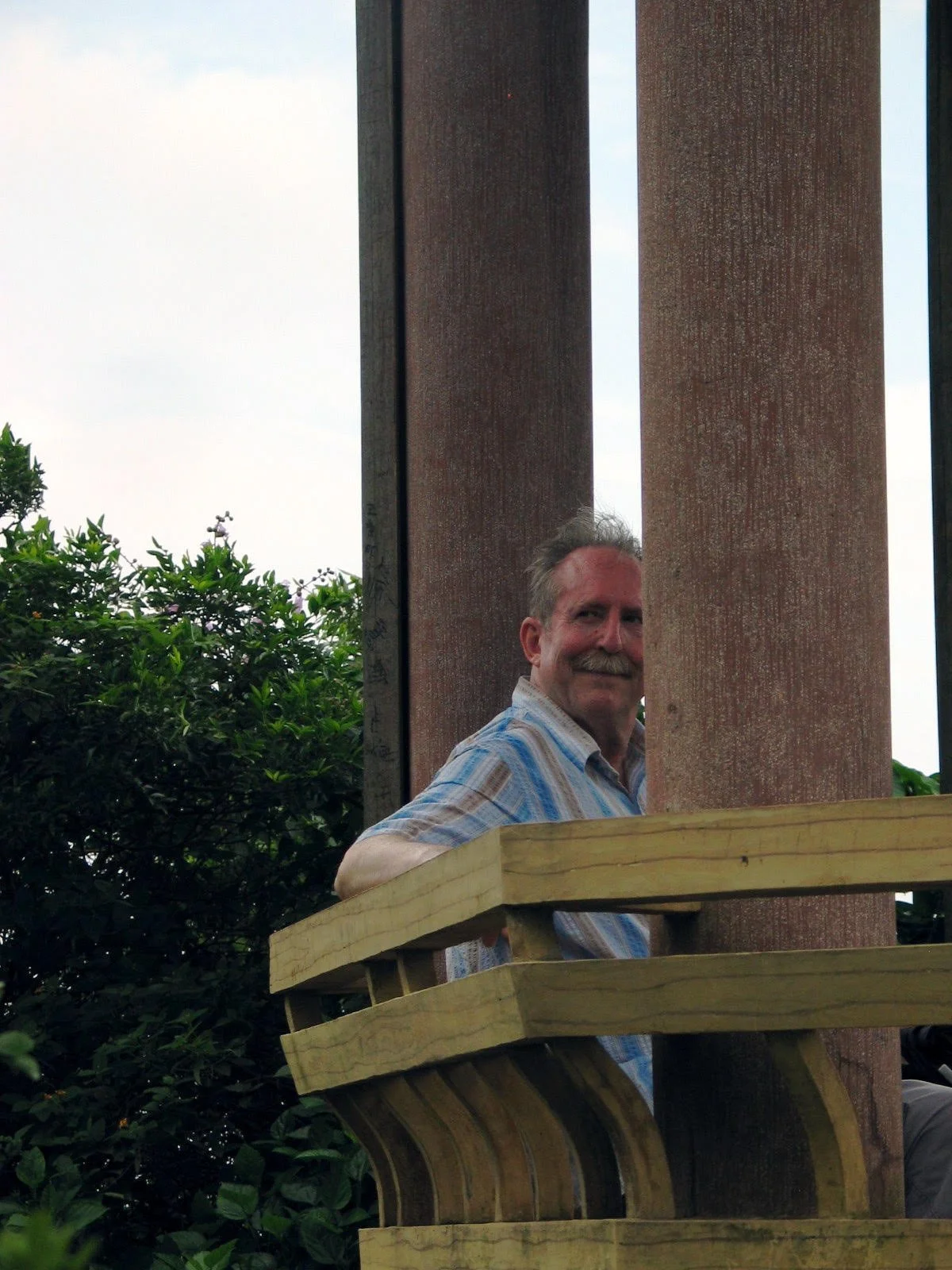
Tom Raworth on Baiyun Mountain near Guangzhou, June 2005 (author’s photo).
[1] All cited poems by Tom Raworth are included in Collected Poems, Carcanet 2003.
*
John Wilkinson is a Visiting Fellow at Clare Hall, Cambridge in 2022-23. His most recent book of poetry is Wood Circle (The Last Books): https://thelastbooks.org/product/wood-circle/ and most recent book of criticism is Lyric in Its Times (Bloomsbury): https://www.bloomsbury.com/uk/lyric-in-its-times-9781350211551/
*
The moral right of the author has been asserted. However, the Hythe is an open-access journal and we welcome the use of all materials on it for educational and creative workshop purposes.